

Visibility in search results is now not just based on the location of a webpage in the listing of search engine results pages (SERPs). Increasingly, AI search engines provide their users with answers directly by producing summaries and synthesising information from multiple sources, resulting in a situation whereby an average user may never even see a traditional SERP.
As a result, the meaning of ranking has changed. Visibility no longer depends on holding a specific position in search results; it depends on whether the AI system selects your content and incorporates it into an answer. When the AI does not choose your content, users never see it, even if it still holds a strong position in traditional search results.
This article breaks down how AI search systems work, explains how they evaluate available content, and defines the conditions required for content to be consistently selected and reused by these systems.
What AI Search Actually Is?
The term AI Search refers to search systems that understand the intent of a question and generate direct answers, rather than simply locating documents that might contain relevant information. Instead of returning a ranked list of web pages, AI-based systems interpret user queries, analyze multiple sources, and synthesize key details into a single, cohesive response that addresses the question as a whole.
Large, deep language models power AI search by enabling systems to understand context, infer intent, and generate a single, comprehensive response. In many cases, AI search delivers answers directly within the search interface, allowing users to get what they need without visiting third-party websites.
The most important aspect of AI search is its focus on delivering answers rather than locating documents. Visibility no longer depends on ranking above thousands of results; instead, it depends on whether the AI actively incorporates your information and cites your source when generating its answer.
What are the Major AI Search Engines?
Generative AI is currently in a rapid growth phase, and new search-like experiences are emerging frequently. While there are many tools in this space, a small number of platforms account for the majority of real-world usage and traffic.
Below are the most influential AI search experiences today, based on adoption and visibility impact.
- ChatGPT: 80.1%
- Google Gemini (AI Overviews and AI Mode): 5.6%
- Perplexity: 1.5%
Chat GPT
ChatGPT is a conversational AI system that utilizes the capabilities of large language models to respond to users’ inquiries and interact with them. It has the ability to access current content on the internet to find the most accurate answers from external sources when browsing is enabled.
ChatGPT does not serve as a conventional search engine, but instead functions as a digital assistant. The user asks questions using everyday language, and ChatGPT generates a structured response that includes references to the top resources available on the internet.
Typical applications of ChatGPT include performing exploratory research, providing technical explanations, and solving challenging problems. Due to its ability to integrate data obtained from numerous sources into one easy-to-read format, ChatGPT serves as a valuable tool for discovering information.

Key characteristics:
- Generates long-form, conversational responses as opposed to listing search results
- Combines historical training data with the most current data available on the internet when browsing is enabled
- Frequently provides citations to the top-tier websites that were used for the responses
- Continues to influence early-stage discovery and research for those who are just beginning their education in a particular subject area.
Google AI Overviews
Google AI Overviews is a new feature that displays an AI-generated summary of the search results above the organic listings. This new feature provides users with a summary of the results on multiple websites with source links. This allows users to get quick answers to their queries without opening every individual page.
With Google AI Overviews, Google’s Search will focus less on traditional ranking of web pages and instead move toward providing users with quality summary information from reliable sources. A web page does not need to rank first to appear in an AI-generated summary, but it must meet Google’s reliability standards to qualify as a trusted source for that summarized content.
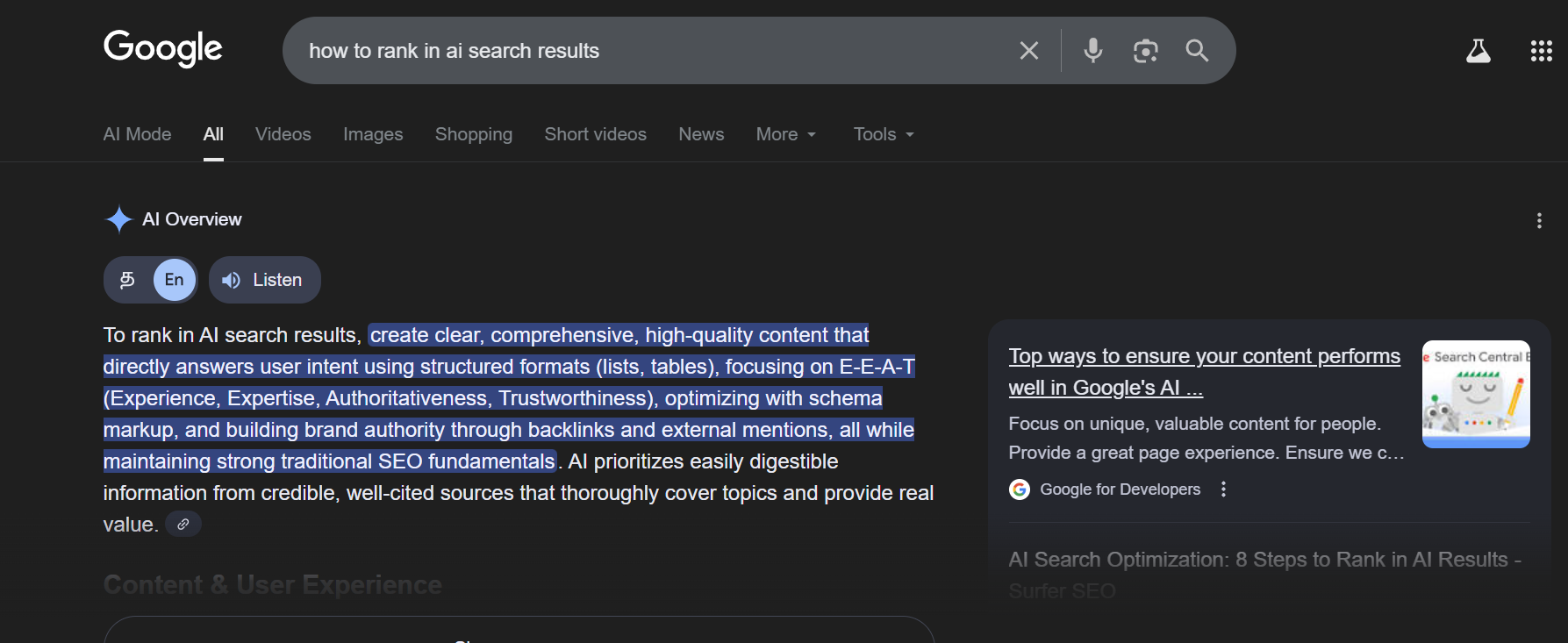
Key characteristics:
- Appears above organic search results
- Provides a combination of information from several different sources in a single summary
- Reduces visibility of search results lower on the page
- Provides websites an opportunity to be included without being ranked first
Google AI Mode
AI Mode is a new way to search that will allow the user to have a dialogue with AI. Instead of the traditional search web page format displaying the search engine results list where users click to view results, this mode of searching provides users with responses from AI in a conversational format (text only or with visual elements), follow-up questions in a natural language, and additional resources relating to the search.
This allows the user to break down questions into components and to view the answers in a logical order, while also allowing for user assistance when performing more complicated tasks on the web using the ChatBot (AI) interface.
This represents a new way of searching by converting searching into an engaging, interactive experience rather than just pointing a user to a webpage.
Key characteristics:
- Full-screen interactive texts between AI and a user
- The ability to ask follow-up questions and use a variety of media
- The ability to gather information from multiple sources with live links
- Utilization of charts, video, summary, and user tasks that can be performed using the AI Mode interface.
Perplexity AI
Perplexity AI is an in-depth, focused AI search engine that delivers concise, referenced answers to users’ queries. Unlike traditional conversational AI, Perplexity relies heavily on paralleled documentation to create a system of reference ‘links’ for accuracy and complete understanding of its sources.
When users submit a query, Perplexity will provide both an overview of its response and an individual link for each source used. The direct links create high volume, highly-targeted referral traffic to these published materials as users are often likely to want to learn more about the topic in question.
Citations and references drive how Perplexity evaluates content. The platform actively verifies accuracy, assesses source credibility, and elevates content that meets clear structural and formatting standards. By favoring well-referenced, consistently presented information, Perplexity ensures that the answers it generates are reliable, easy to interpret, and safe to cite.

Key characteristics:
- Purpose-built, AI-driven search engine with visible citations
- Create links back to blogs/news forums, etc. – Generates significant, direct clicks on those links to the original source for deeper investigation.
- Significant traffic routed back to the original source of content from the highlighted/static website.
AI Search vs Traditional Search Engines
In traditional searches, the ranking of documents was used to help locate the result that would best meet each user’s needs. Therefore, the success of traditional search engines depended on the position of the ranking, number of click-throughs, and level of page optimization.
AI-based search engines offer a fundamentally different approach. Rather than determining which documents should be displayed in response to a query based on their ranking, AI-based search engines evaluate multiple sources of relevant information and determine which explanations may be reused safely and accurately based on how well they fit the user’s intent.
In traditional search, a search engine judges relevance using keywords and link signals. In contrast, AI-based search engines actively evaluate relevance by measuring how clearly an answer explains the topic, how completely it resolves the user’s question, and how reliable the source is. By doing so, AI-driven systems apply a broader set of criteria, including a source’s ability to demonstrate genuine understanding of the subject matter
As a result of this difference, AI-based search behaves more like an editorial process than an index. AI-based search engines utilize the confidence of their findings to select, summarise, and, at times, exclude content.
Types of AI Search Experiences
The concept of AI search doesn’t exist in just one format. Many different types of AI search exist and depend on how each service selects and presents information. The same models often underlie these various formats; however, each service has established different amounts of visibility of AI-generated content based on how users experience them.
AI Overview & Generative Panels:
These panels display AI-generated summaries at the top of individual Shopping pages in Google search results. Instead of listing numerous links like traditional search, AI Overviews actively consolidate information from multiple sources into a single response. As a result, content gains visibility only when the system selects it for inclusion in the summary, not because it ranks higher among links on the Shopping page.
Conversational Search Interface:
A conversational search interface provides the ability for users to ask additional questions and learn about other subjects through a continuous dialogue with the AI. The AI utilizes its ability to maintain context throughout the conversation so that the sources that were present during the early part of the conversation are very likely to be reused again when the user reaches the completion stage of the conversation.
Voice-Based AI Assistant:
Voice search uses a single spoken response and typically does not include any visual alternative options for the user’s selection of a source. Because the user receives only a single response, the importance of selecting the right response becomes critical. The AI will only select one source (or a synthesized version of several sources) and will revert to the previous example; if the user does not select that content, they will not be able to access it at all.
In all of these formats, the fundamental transition that has happened within AI search is that selection has overthrown listing as the priority for AI search. Therefore, having content included in an AI Overview or Voice-based assistant is much more important than its traditional rank position.
How AI Search Engines Generate Answers?
AI search engines generate answers through a multi-stage process. They interpret the user’s question, determine the information required for an accurate response, and select sources they can use with confidence. Each stage actively filters and refines information before the system produces an answer.
1. Query Interpretation and Intent Modeling
Instead of using keyword matching as traditional search engines do, AI search engines look at the user’s intent. They analyze all available information to accurately determine what the user wants. In many cases, AI search engines actively combine multiple pieces of information to answer a user’s query and construct responses using this layered approach.
2. Topic Expansion and Contextual Framing
Once the user’s intent has been identified, the next step is to expand the user’s topic by presenting a range of related concepts. By doing this, the AI search engine is able to generate an answer that is comprehensive rather than limited to a small portion of information. AI search engines also benefit from being able to easily incorporate existing definitions, contextual information, and information boundaries when creating responses.
3. Source Evaluation and Confidence Scoring
After an AI system establishes a topic, it actively evaluates and scores source quality. It actively evaluates how clearly the content communicates, checks internal consistency, compares the explanation against established consensus, and measures how trustworthy the source has proven to be over time. Sources that introduce contradictions, rely on vague or unsubstantiated claims, or prioritize promotional messaging lose credibility until multiple independent sources verify the information and increase confidence in its accuracy.
4. Answer Synthesis and Reuse
Finally, the AI synthesizes a single comprehensive response by developing a “summary” or “compilation” of information gathered from various sources rated as credible.As new queries arise, AI systems actively reuse the sources they have already identified as high-quality and credible in previous searches. The repeated utilization of these sources creates greater “visibility” for that specific source(s) on future AI searches.
How Ranking Works in AI Search
Unlike the traditional search systems, which evaluate web pages individually, AI search systems now use the overall reputation and trust level of the website hosting the page to determine the visibility for a search result. As a result, AI systems determine a source’s visibility by how frequently they reference, reuse, and trust it over time, rather than by the standalone visibility of individual pages or websites. This shift is indicative of how AI search is relying on a source-based credibility for sustained visibility, rather than relying solely on the visibility of a page at a single point in time.
Why AI Evaluates Sources, Not Individual Pages
AI search systems look beyond the visibility of individual pages and evaluate the overall trustworthiness of the entire source, including the author, brand, and platform. Sources that consistently publish clear, accurate, and thematically cohesive content build trust over time. In contrast, a single strong article does not provide enough signal for the system to assume ongoing reliability without supporting content from the same author or website.
How Repeated Selection Builds Dominance
AI systems that select a source multiple times will develop a trust level with respect to that source’s reliability. When AI systems trust a source, they have less incentive to search for and evaluate the reliability of other possible sources for similar queries, thus developing a positive feedback loop. The result is that AI-generated responses often have only a few, highly visible sources for many search queries.
What AI Considers Before Using Content
AI search engines deliver accurate and trustworthy answers by actively minimizing uncertainty in their results. They evaluate how clearly content represents the subject, compare it against reliable information from other trusted sources, and assess how safely they can reuse that information across multiple user queries.
Explanation Quality Over Optimization
AI Search Engines use content that is most accurately interpreted by the AI Search Engine based on the quality of the information provided. This means that AI Search Engines are looking for information that clearly explains concepts and topics. Information that explicitly defines terms, explains relationships, and logically guides the reader through a topic is the type of information that AI Search Engines find easy to read, summarize, and develop an understanding of.
Keyword placement, aligned headers and metadata, and strong user experience help AI search engines discover content more easily, but they cannot compensate for weak explanations. When a piece of content fails to explain a concept clearly or in sufficient depth, AI systems avoid selecting it – even if the page is technically well optimized.
Alignment With Consensus
Additionally, AI search engines actively compare explanations against reliable sources and established consensus to judge accuracy and safety. When multiple trusted sources explain the same concept in a consistent way, AI search engines gain stronger confidence that the information is correct, dependable, and safe to surface in results.
However, if there are conflicting explanations of the same topic between alternative reliable sources, the AI Search Engines will need to find a way to resolve the conflict before determining whether or not they can safely use any of the conflicting explanations.
Why Being First Matters Disproportionately?
AI search does not distribute attention evenly across sources. Instead, visibility concentrates on sources that the system selects early and repeatedly. Benford’s Law reflects this same pattern, where leading positions dominate uneven distributions. Because early selection influences long-term visibility far more than incremental ranking improvements later, securing early inclusion plays a critical role in whether a source remains discoverable over time.
Understanding Benford’s Law in Search Contexts
Benford’s Law shows that early positions in a distribution attract disproportionate attention and usage. AI search reflects this same pattern in how it selects and reuses sources. Once an AI system establishes trust in a source, it repeatedly defaults to that source for related queries, reinforcing its visibility over time.
As AI systems reuse a source, they actively strengthen confidence in its reliability. This growing confidence reduces the likelihood that the system will evaluate alternative sources. Sources that gain visibility early therefore increase their chances of continued selection, reuse, and dominance as AI systems evolve. Over time, this creates a compounding effect in which a small number of trusted sources capture most visibility, rather than AI distributing attention evenly across many options.
Impact on AI Overviews and Voice Search
AI Overviews typically generate answers using one or two sources, and users tend to focus on the summarized response rather than exploring alternative explanations. When a source appears at the top of this summary, it strongly shapes how the topic is presented and understood.
The amplification of this effect is seen in the voice-activated AI search space, where only one answer is returned. There are no visual comparisons or secondary results until the user requests more information. In the case of voice-enabled AI search, being first not only gives content a better chance of surfacing; it also establishes a trust relationship, which makes securing an early position critical to being able to find it.
Content Completeness as a Core Ranking Signal
What Completeness Means in AI Search?
In AI search, completeness refers to how fully an explanation resolves the user’s question and its immediate follow-ups. A complete explanation defines key concepts, explains how they work together, and clarifies relevant limitations without drifting into unnecessary detail. It is not about covering every possible angle, but about closing the logical loop so the answer feels finished. Content that achieves this reduces the need for the AI system to search elsewhere for clarification.
Why AI Systems Exclude Partial Answers?
When an AI encounters partial responses, it creates gaps in its knowledge base, which limits its ability to connect information and deliver a complete answer. Gaps in context or logical flow increase uncertainty and force the AI to rely on multiple sources to fill missing pieces. This reliance dilutes source consistency, reducing the likelihood that the system will repeatedly reuse a single reference. While search engines may still index content that only partially answers a question.
How AI Evaluates Content Quality?
Clarity and Precision
The creation of accurate content should include a clear message that allows readers to fully comprehend what is being communicated. An exact message allows a reader to easily interpret the meaning of that exact message, to isolate the most important points from that exact message, and to incorporate an explanation of the exact message back into their writings without altering the actual meaning of the initial explanation.
Any use of vague language or excessively long sentences, as well as any usage of poorly defined terms, increases the risk of content being misinterpreted.
When creating good content for an AI search:
- All terms should be defined clearly and precisely
- Use language that communicates clearly without using figurative language or exaggeration
- Present material in a logical and orderly fashion (e.g. Idea number one leads into Idea number two leads into Idea number three)
- Avoid using too much jargon or extra words that do not convey meaning
- The clearer the message, the less uncertainty. The less uncertainty there is about that message, the greater the likelihood that the content will be selected.
Consistency Across Sections
AI systems will look for consistency in reasoning between different sections of a document. If the author’s definition of a specific word, claim or conclusion changes between two sections, the reader will find it difficult to trust the content as a whole. It is clear from this point that consistency indicates to the reader that the author of that document is knowledgeable about the subject matter.
Consistency is further confirmed when:
- The same word is used consistently throughout the document
- The author’s explanations of concepts do not contradict themselves
- The examples presented support the main argument
- The author’s recommendations regarding a subject are consistent with the author’s explanations
AI systems will trust and will be able to reuse any content that has internal consistency in multiple searches.
How Structure, Format, and Technical Foundations Enable AI Selection?
AI search systems rely on how information is organized as much as what it says. Unlike human readers, AI models extract meaning in segments, using structure and formatting cues to understand purpose and relevance. Content that is poorly structured or technically unstable increases uncertainty and is less likely to be reused, even if the explanation itself is strong.
Why AI Needs Predictable Structure?
Predictable structural formats are critical to an AI systems ability to extract accurate answers. A table-formatting style with clearly labelled headings, logical order of sections, and paragraphs grouped by related content help an AI system find the location of an answer to the question and the relationship of that answer to other ideas. The incoherent use of structure forces the AI system to deduce the intent behind the way the structure is written, thus increasing risk.
Structured formats provide AI with:
- The ability to quickly locate the direct response to a question
- The ability to differentiate between definitions and explanations
- The ability to accurately summarise content without changing the original meaning.
Because structured formats provide the AI with easier access to the information contained within an organisation, it creates a greater potential for reuse of well-structured pages across AI-generated responses.
Role of Tables and Comparisons
Tabular-formatting and structured-comparison formats reduce ambiguity by specifying the relation of one idea to another. For decision-based and evaluative queries, the clarity of the information provided is more important than the flow of ideas through narrative format. Because tabular-formatting styles provide consistent structure, AI systems can extract and reuse them, which lessens the time required to interpret.
Structured comparisons work well for:
- Outlining similarities and differences between options
- Comparing two or more approaches, methods or tools
- Presenting limitations, steps or trade-offs
Each of these reasons makes the structured-comparative-format a reliable source of input for AI-summary creation.
Technical Accessibility as a Prerequisite
Technical accessibility is what tells us if it’s possible to access the content for assessment at all. Before assessing content on a web page with an AI system, the page must load consistently, render correctly, and be completely crawlable. If a page fails to meet any of these criteria, the evaluation will not even begin.
Examples of typical roadblocks include:
- Slow/Unstable Page Loading
- Broken Layouts/Rendering Problems
- Non-Crawlable Content/Blocked Resources
Technical stability does not guarantee selection, but technical failure immediately excludes a page from the evaluation process.
Citations, Trust, and Visibility Accumulate Over Time in AI Search
AI search engines build up trust gradually by observing how sources perform across repeated queries, rather than treating each query as an independent query. AI systems will provide increased visibility over time as a result of repeatedly receiving consistent and accurate contributions from a source.
How AI Chooses Which Sources to Cite
AI systems prefer to cite sources that have a reliable history of producing or providing accurate answers. Therefore, the systems maintain a list of pre-approved sources that are reliable, and thus the systems have less burden to review other potential sources when answering a similar query.
Factors influencing the Selection of Sources by AI:
- The clearness and accuracy of the provided explanations
- The consistency of the content from those sources
- The fit or agreement of the sources with respect to the information found on other trusted sources
- Once a source has demonstrated its reliability, it is always a default resource to cite.
Why Repeated Citation Matters More Than One-Time Visibility
Single appearances do not establish trust. What AI systems value is repeated successful reuse: that the source performs reliably across contexts. Every reuse strengthens the confidence in it, hence making future selection more likely.
Over time, this leads to:
- Visibility among the sources of trust concentration.
- Less exposure for one-time or occasional contributors
- Compounding advantage of early, reliable sources
- Trust in AI search is cumulative, not instant.
Measuring Visibility Beyond Traditional Metrics
AI visibility is not captured fully through traditional metrics such as clicks and sessions. The number of answers yielded from AI will satisfy user intent without sending any traffic to the source, therefore making it difficult to measure direct visibility.
Other Indicators of AI Visibility:
- Recurring mentions or citations in AI responses.
- Paraphrased explanations: The details in your content are just paraphrased.
- More brand awareness, but not as much an increase in the website traffic.
- In AI search, visibility is defined by reuse and trust-not just engagement.
Conclusion
The meaning of ranking has changed due to the introduction of AI search. Previously, the rank and click-through rates (CTR) were the deciding factors of visibility and ranking. Now, AI systems will only choose to retrieve content because they feel confident that the source has answered the question. Therefore, the confidence in a specific source relies on the source having provided clear reasoning, reliable structure, and explanation of the content that reduces uncertainty; thus, AI systems will continually use and retrieve pages that assist them in accurately explaining a specific topic.
At every stage of the search process from interpreting the query to synthesizing the final answer AI systems actively evaluate content in the same way. Deeper, topic-focused sources actively increase their chances of recognition, while consistently structured and predictably formatted explanations across a subject area actively drive sustained visibility within AI-generated results.
Visibility is cumulative in AI search. Having one high-performing page will not necessarily be sufficient; visibility will increase with each instance that a source has established itself as a trustworthy source of clear and consistent information. As AI continues to improve, with fewer answers from the AI system to users and more direct answers provided to users, the advantage will increasingly go to those sources that prioritize clarity and user understanding as opposed to simply creating content for the purpose of optimizing for search engine ranking.
FAQs
1. Does ranking high in Google automatically mean visibility in AI search?
No. Traditional rankings and AI visibility operate on different signals. A page can rank highly in classic search and still fail to earn AI selection if its explanations lack clarity, completeness, or consistency. AI search actively prioritizes sources that enable confident answer generation, not pages that merely perform well in rankings.
2. Can small or new websites appear in AI-generated answers?
Yes but consistency matters more than size. AI systems do not reward scale; they reward reliability. A brand doesn’t need to be large to earn visibility, but it must demonstrate trustworthiness over time. Smaller sites that go deep on a specific topic, present explanations consistently, and structure content with clarity can earn selection especially within niche or emerging subject areas where focused expertise stands out.
3. Will AI search eventually replace traditional search rankings completely?
Not in the near term. AI search is expanding how systems deliver answers, but traditional rankings still support discovery, validation, and deeper exploration. What is changing is how platforms actively distribute visibility: AI-generated answers now sit above traditional results and shape what users see first.