

Every organization today relies on data, but few truly know how to handle it efficiently. The growing volume, speed, and variety of data have made traditional engineering methods slow, complex, and costly creating an urgent need for AI Powered Data Engineering to bring automation and intelligence into the process. Teams spend hours fixing broken pipelines, managing manual workflows, and trying to keep up with ever-changing demands.
As a result, valuable insights are delayed, decision-making slows down, and innovation takes a back seat. The tools that once worked for small datasets can no longer sustain the real-time demands of modern analytics.
This is where a smarter, faster, and more adaptive approach steps in one that uses artificial intelligence to automate and optimize the entire data lifecycle. From AI-Driven ETL Automation to Real-Time Data Processing with AI, this transformation is reshaping how we collect, manage, and use data to drive business success.
The Need for AI in Modern Data Ecosystems
Why Traditional Data Engineering Methods Fall Short
Today’s data landscape is expanding at a pace that traditional systems cannot manage. Modern data ecosystems now pull information from:
- IoT devices generating continuous real-time data
- SaaS platforms creating high-volume event streams
- Cloud applications with constantly evolving schemas
- Real-time interactions across websites, apps, and digital touchpoints
- Unstructured formats such as logs, text, images, and sensor outputs
As these data sources multiply, the limitations of traditional engineering practices become clearer. Older ETL tools and on-prem infrastructure simply weren’t built for today’s volume, velocity, and variety.
Engineering teams often face issues like:
- Frequent schema breaks that disrupt data pipeline automation
- Manual code fixes that slow down development cycles
- Batch pipelines that delay insights due to long processing times
- High operational costs linked to scaling outdated systems
- Limited visibility into pipeline health or data quality concerns
This is where modern AI approaches make a difference. With machine learning in data engineering, pipelines can identify pattern shifts, predict failures, and adapt automatically. Intelligent systems support smoother pipeline automation, reduce human intervention, and keep data flowing reliably in fast-changing environments.
What Exactly Is AI Powered Data Engineering and Why It Matters
AI Powered Data Engineering combines traditional data engineering principles with the intelligence of machine learning, automation, and predictive algorithms. Instead of relying solely on human intervention, these systems continuously learn from data behaviors and automatically adjust pipelines for better performance and accuracy.
Think of it as having a digital co-engineer that helps manage ingestion, transformation, and delivery of data only faster and more precise. With AI handling repetitive tasks, engineers can focus on innovation, modeling, and building scalable architectures.
In other words, AI in Data Pipeline Automation isn’t about replacing humans, it’s about amplifying their efficiency and enabling better, data-driven outcomes.
Why AI in Data Engineering Is No Longer Optional
The integration of AI into data engineering isn’t just another tech trend, it’s a necessity born out of scale and complexity.
- Faster Time to Insights: AI can process and prepare data in seconds, improving decision-making speed.
- Cost Efficiency: Automated monitoring reduces downtime and manual maintenance.
- Scalability: Through Cloud-Based Data Pipelines, systems can easily expand without performance loss.
- Consistency: Machine learning ensures every data flow maintains the same quality standards.
- Future-Readiness: Businesses adopting AI-driven models now will adapt better to evolving data demands.
These Benefits of AI in Data Engineering go beyond convenience they help organizations stay competitive, efficient, and intelligent in an increasingly data-saturated world.
The Core Building Blocks of AI Powered Data Engineering
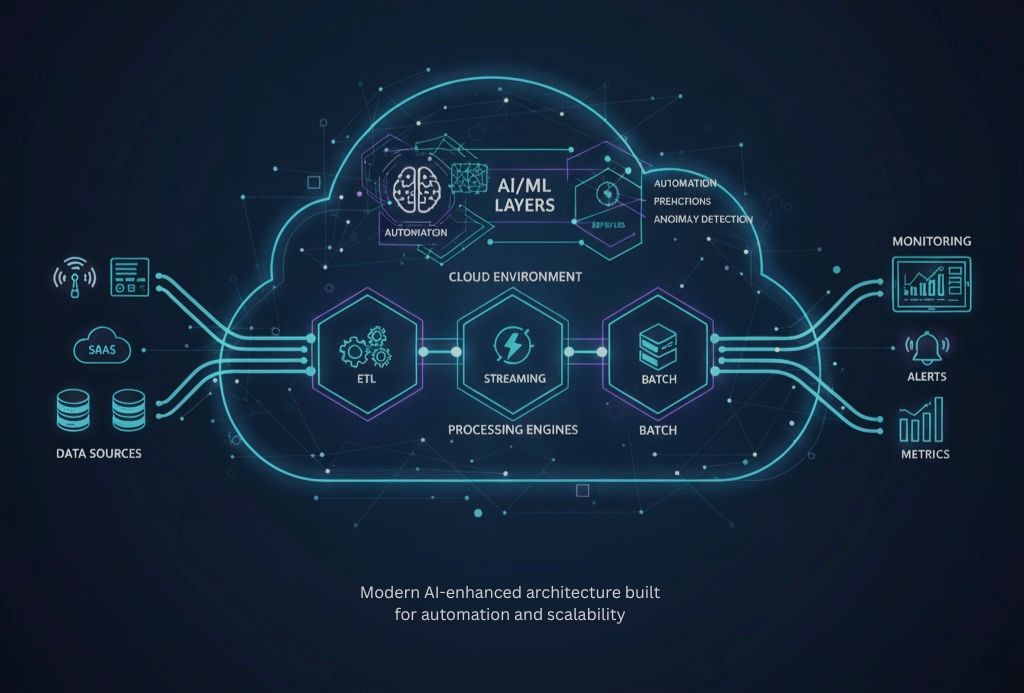
- AI in Data Pipeline Automation – automates ingestion and scheduling, adapting to workload changes.
- AI-Driven ETL Automation – detects schema changes, validates data, and handles errors autonomously.
- Cloud-Based Data Pipelines – ensure flexible, global, and secure access to scalable datasets.
- Machine Learning in Data Engineering – improves classification, anomaly detection, and performance.
- Monitoring and Optimization – continuous evaluation for performance tuning and issue prediction.
By automating these areas, teams save time, reduce human error, and deliver higher-quality outputs all while maintaining transparency and control.
How Data Engineering and AI Solutions Are Changing Industries – Examples
- Retail: Predicting demand and optimizing inventory through Real-Time Data Processing with AI.
- Finance: Detecting anomalies and preventing fraud using AI-Driven ETL Automation.
- Healthcare: Streamlining patient data systems with Cloud-Based Data Pipelines.
- Manufacturing: Reducing downtime via predictive maintenance models.
Companies using the Best AI for Data Engineering aren’t just improving speed they’re transforming accuracy and reliability across their ecosystems.
Building Trust Through Intelligent Automation in Data Engineering
Adopting AI doesn’t mean losing control. It means building trust through transparency and consistency. When automation is properly implemented:
- Data lineage becomes traceable.
- Errors are caught before they impact production.
- Performance improves without micromanagement.
This balance of human oversight and AI precision ensures businesses can scale responsibly while maintaining compliance and governance.
In short, Data Engineering Services & Solutions powered by AI create a foundation where trust and technology coexist seamlessly.
Overcoming Common Challenges in AI Powered Data Engineering
- Model Drift: Retrain models regularly to adapt to data changes.
- Integration Complexity: Start small and automate one pipeline at a time.
- Data Security: Encrypt and control access within Cloud-Based Data Pipelines.
- Team Readiness: Train engineers to understand both AI and traditional systems.
By addressing these challenges early, organizations ensure sustainable growth and smoother adoption.
The Future of AI Powered Data Engineering
The future is intelligent, scalable, and autonomous. AI will continue to push data engineering toward:
- Fully automated pipeline creation
- Real-time anomaly response
- Intelligent data categorization
- Self-optimizing data architectures
- AI-driven governance frameworks
Businesses that adopt AI today will lead tomorrow’s data-driven landscape.
Conclusion
AI Powered Data Engineering is more than a technology shift it’s a smarter way to work with data. Combining automation, intelligence, and scalability unlocks data’s full potential while keeping quality and trust intact.
The future of data isn’t just about storing it it’s about making it think.
FAQs
1. How does AI improve data quality and build trust in engineering workflows?
AI Powered Data Engineering enhances reliability by detecting anomalies, schema drift, and data errors early.
It learns from normal data patterns, keeping information accurate and consistent.
This ensures cleaner, more transparent Cloud-Based Data Pipelines and strengthens overall trust in data-driven decisions.
2. What are the most helpful tools for AI Powered Data Engineering?
Reliable, production-proven tools make AI integration smoother:
- Apache Airflow / Dagster – pipeline orchestration
- Databricks / Apache Spark – batch & streaming compute
- dbt / Snowflake / Big Query – transformation & analytics
- Great Expectations / Soda – data quality validation
- ML flow / Feast / Vertex AI – ML lifecycle management
- Data Hub / Amundsen – metadata & lineage tracking
These tools bring scalability, automation, and visibility to every AI Powered Data Engineering project.
3. How does AI support real-time decision-making in modern data systems?
AI enhances real-time decision-making by processing incoming data streams instantly and identifying insights the moment patterns appear.
Through machine learning in data engineering, it prioritizes critical signals, flags anomalies, and enriches data before it reaches dashboards or applications.
This instant intelligence helps businesses react faster, improve customer experiences, and stay ahead in fast-moving environments.